Understanding medical billing codes can feel confusing. Many codes look similar. Small mistakes can lead to claim denials. One commonly used code is 96372. This article explains the 96372 CPT code description in simple terms. It is written for medical billers, coders, providers, and students.
If you want clarity without technical overload, you are in the right place.
What Is the 96372 CPT Code?
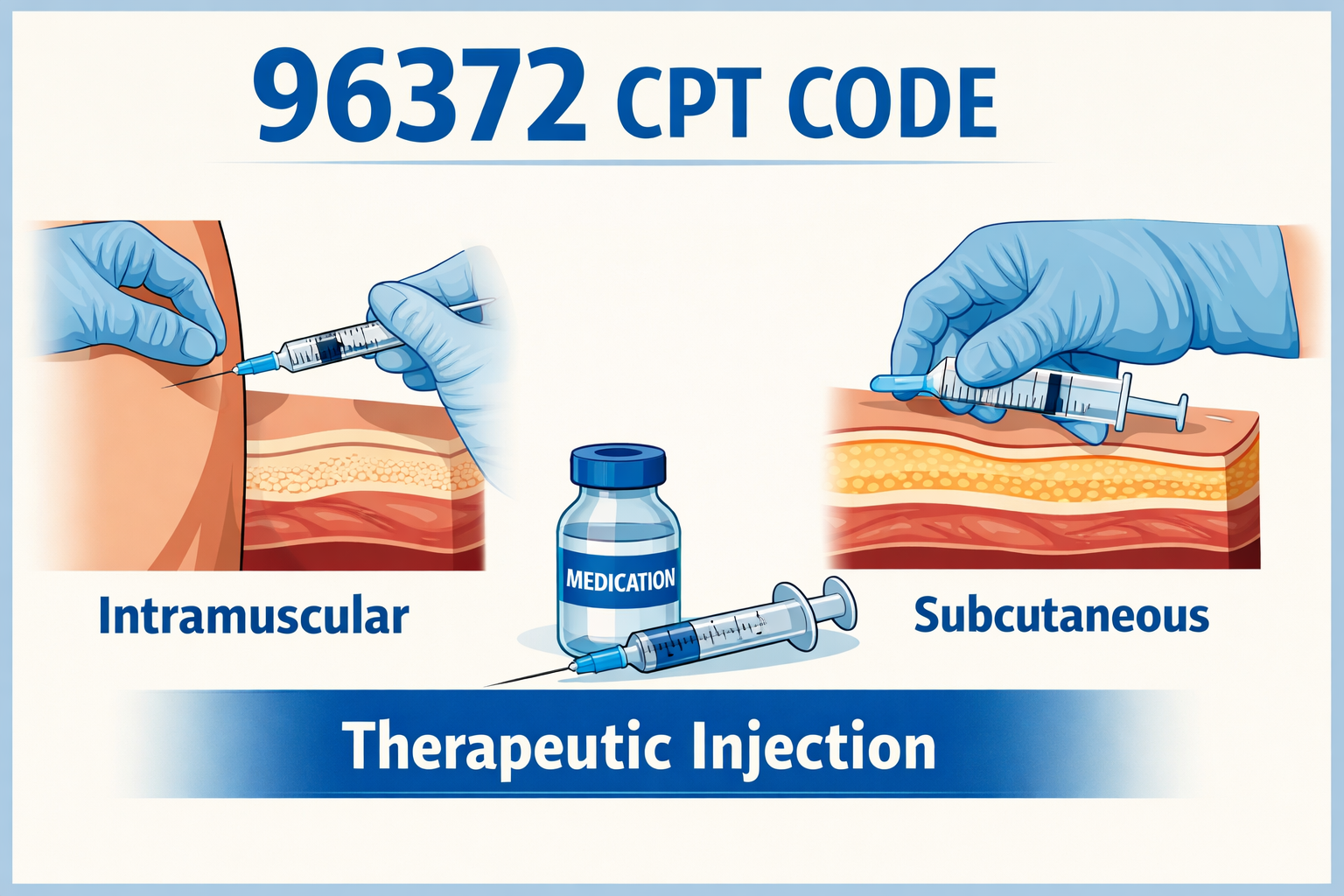
The 96372 CPT code description refers to a therapeutic, prophylactic, or diagnostic injection. It is given by intramuscular or subcutaneous route. The injection is not an infusion. It is a standalone service.
In simple words, this code is used when a healthcare provider gives an injection directly into muscle or under the skin.
It does not describe the medication.
It only describes the administration of the injection.
Official 96372 CPT Code Description
The official 96372 CPT code description is:
“Therapeutic, prophylactic, or diagnostic injection (specify substance or drug); subcutaneous or intramuscular.”
This description matters for correct billing. It clearly separates injections from infusions or IV pushes.
When Is CPT Code 96372 Used?
CPT code 96372 is used in many routine medical visits. Providers use it when the injection is given outside of an IV line.
Common situations include:
-
Vitamin B12 injections
-
Hormone injections
-
Allergy shots (when appropriate)
-
Pain management injections
-
Antibiotic injections
The 96372 CPT code description applies only to the act of giving the injection. The drug itself is billed separately.
Routes Covered Under 96372 CPT Code
The 96372 CPT code description includes two routes:
Intramuscular (IM)
This injection goes deep into the muscle.
Common sites include the arm or hip.
Subcutaneous (SubQ)
This injection goes under the skin.
It is usually given in the abdomen or thigh.
If the injection uses these routes, 96372 is usually correct.
What 96372 Does NOT Include
Understanding exclusions is very important.
The 96372 CPT code description does not include:
-
IV infusions
-
IV push injections
-
Injections given during surgery
-
Injections bundled with other procedures
If an injection is part of another service, 96372 may not be payable.
Billing Guidelines for CPT Code 96372
Billing 96372 requires attention to detail. Many denials happen due to simple errors.
Here are key billing rules:
-
Bill one unit per injection
-
Do not bill with certain evaluation codes without modifier
-
Document medical necessity clearly
-
Identify the drug with correct HCPCS code
The 96372 CPT code description supports billing only when the injection is medically necessary.
Modifier Usage With 96372 CPT Code
Modifiers are often required.
Modifier 25
Use this when a significant evaluation and management (E/M) service is performed on the same day.
Example:
A patient is evaluated and then receives an injection.
Modifier 25 may be required.
Modifier 59
This modifier may apply if the injection is separate from another procedure.
Correct modifier use protects reimbursement.
Documentation Requirements
Good documentation is essential.
The medical record should include:
-
Reason for injection
-
Drug name and dosage
-
Route of administration
-
Injection site
-
Provider signature
Without this, claims may be denied. The 96372 CPT code description relies heavily on accurate notes.
Common Diagnosis Codes Used With 96372
Diagnosis codes justify the injection.
Common ICD-10 codes include:
-
Vitamin deficiencies
-
Hormonal disorders
-
Pain conditions
-
Inflammatory conditions
The diagnosis must support the service. The 96372 CPT code description alone is not enough.
Medicare and CPT Code 96372
Medicare has strict rules.
Medicare often bundles 96372 into other services. In many cases, it is not separately reimbursed.
Always check local coverage determinations. The 96372 CPT code description may be valid, but payment rules still apply.
Commercial Insurance and 96372
Private insurers are more flexible. Many allow separate payment for 96372.
However, policies vary. Always verify benefits. Even though the 96372 CPT code description is standard, payer rules differ.
Common Mistakes to Avoid
Many billing errors happen with this code.
Avoid these mistakes:
-
Billing without a drug code
-
Missing modifiers
-
Poor documentation
-
Billing with bundled services
-
Using wrong injection route
Knowing the 96372 CPT code description helps reduce errors.
Why 96372 Is Important in Medical Billing
This code appears simple. Yet it affects revenue.
Used correctly, it ensures fair payment. Used incorrectly, it leads to audits or denials.
Understanding the 96372 CPT code description improves compliance and billing accuracy.
Difference Between 96372 and Similar Codes
It is easy to confuse codes.
-
96372: IM or SubQ injection
-
96365–96368: IV infusions
-
96374: IV push
Always match the route. The 96372 CPT code description applies only to non-IV injections.
Real-World Example
A patient visits a clinic for fatigue.
The provider evaluates the patient.
A B12 injection is given intramuscularly.
Billing may include:
-
E/M code with modifier 25
-
96372 for injection administration
-
J3420 for B12 medication
This is a correct use of the 96372 CPT code description.
Consolation
The 96372 CPT code description plays a key role in outpatient care. It supports billing for simple yet essential injections. When used correctly, it ensures smooth claims processing.
Accuracy matters. Documentation matters. Modifier use matters.
Learning this code well saves time and money.
Fast Facts
-
CPT code: 96372
-
Service type: Injection administration
-
Routes covered: Intramuscular and Subcutaneous
-
Drug billed separately
-
Commonly denied without modifier
-
Medicare often bundles it
-
Documentation is critical
-
Used in clinics and offices
-
Not for IV injections
-
High-use code in outpatient billing